News

Efficiency Unleashed: The Case for Automated Testing

Discover how automated testing is transforming the landscape of mobile operator services, improving efficiency, and ensuring flawless user experiences. Explore the advantages of Acctopus Degust, a cutting-edge tests and monitoring automation system, to streamline operations and enhance service quality.In today’s fast-paced digital age, the demand for seamless and uninterrupted mobile operator services is higher than ever. As users rely on their devices for communication, entertainment, and business transactions, the pressure on mobile operators to deliver impeccable service experiences has escalated. This is where the power of automated testing comes into play, revolutionizing the industry and redefining efficiency. The Evolution of Testing in Mobile Operator Services Traditionally, testing mobile operator services involved manual and time-consuming processes. Engineers had to manually simulate user interactions, network scenarios, and wait for system responses to identify potential glitches and weak points. This approach was not only labor-intensive but also prone to human errors, often leading to undetected issues slipping through the cracks and causing service disruptions. Automated testing has changed this landscape dramatically. By leveraging sophisticated software and tools, mobile operators can now simulate and evaluate a wide range of scenarios rapidly and accurately. This includes testing within the operators’ core systems, signaling communication, Service Order Management (SOM), and Customer Order Management (COM). Even more impressively, end-to-end (E2E) tests are made possible through Acctopus Degust’s innovative Explorers. Revolutionizing Testing At the forefront of this testing revolution is Acctopus Degust, a comprehensive tests and monitoring automation system designed specifically for mobile and fixed operators. Acctopus Degust introduces a new era of testing efficiency by allowing operators to simulate signaling communication within their core systems, SOM, COM, and even conduct E2E tests using the Degust Explorers. The Degust Explorers, acting as 2G-5G User Equipment (UE) or Fiber-connected devices, emulate user behaviors and interactions with the network. This dynamic testing approach offers a holistic perspective of service quality, identifying potential bottlenecks and vulnerabilities that might escape traditional testing methods. Advantages of Acctopus Degust Enhanced Efficiency: Acctopus Degust accelerates testing processes, reducing time-to-market for new services and updates. Its automated simulations enable comprehensive testing in a fraction of the time it would take manually. Flawless User Experiences: With E2E tests and user behavior simulations, Acctopus Degust ensures that the end-user experiences seamless services across different scenarios and network conditions. Cost Savings: By automating testing processes, mobile operators minimize the resources required for manual testing, resulting in significant cost savings. Realistic Scenarios: The Degust Explorers mimic real user interactions, offering insights into actual service performance under various conditions, which is crucial for maintaining high-quality services. Reliability: Automated testing eliminates the risk of human errors, improving the accuracy and reliability of test results. In conclusion, the era of manual testing in mobile operator services is giving way to a new era of efficiency and quality assurance through automated testing. Acctopus Degust stands at the forefront of this transformation, enabling mobile operators to streamline operations, deliver flawless user experiences, and stay competitive in a rapidly evolving industry. Embrace the power of automation with Acctopus Degust and unlock the full potential of your mobile operator services.

Efficiency Unleashed: The Case for Automated Testing Read More »

What is mobile handover?

Mobile Handover explained

Handover is a function of mobility in mobile networks. In brief, whenever a mobile UE moves, it leaves and joins areas, the mobile cells. The process of handing over into the next cell is called Handover.Handover has been around for more than 3 decades but has been discussed a lot since the start of 5G networks. Has handover been mainly a function of the radio access type the mobile is currently connected to, since the start of 5G, we have got many more options, which I’ll try to explain in this post. In 4G and 5G Non-Standalone (NSA) mode, handovers between cells are performed using a protocol called X2. X2 handover is a type of inter-eNodeB (eNB) handover which allows a mobile device to switch between cells controlled by different eNBs. When a mobile device moves from the coverage area of one eNB to another, the new eNB sends a handover request message to the current eNB, which then initiates the handover process.In 5G Standalone (SA) mode, handovers between cells are performed using a protocol called Xn handover. Xn handover is similar to X2 handover, but it is used for inter-gNodeB (gNB) handover, which allows a mobile device to switch between cells controlled by different gNBs. This new protocol provides more flexibility and allows more advanced features such as dual connectivity, which allows the mobile device to connect to multiple cells simultaneously, and inter-frequency handover, which allows the mobile device to switch between different frequency bands within the 5G network during the handover process.In summary, X2 Handover is used in 4G and 5G Non-Standalone (NSA) mode, and it’s used for inter-eNodeB (eNB) handover, while Xn Handover is used in 5G Standalone (SA) mode and it’s used for inter-gNodeB (gNB) handover, providing more flexibility and advanced features. In 4G, handover scenarios between cells typically take place in one of two ways: hard handover or soft handover. In hard handover, the mobile device disconnects from the current cell before connecting to the new cell. In soft handover, the mobile device maintains a connection with both the current and new cells during the handover process.In 5G Non-Standalone (NSA) mode, handovers are performed between 4G and 5G cells using the same techniques as in 4G. In addition, 5G also supports a feature called dual-connectivity, which allows a mobile device to be connected to both a 4G and 5G cell simultaneously, resulting in improved handover performance.Let’s think of testing a handover.As described, handovers will be initiated as soon the cell the phone is connected  will become less significant, meaning less quality and signal strength.The key in testing is to force the degradation in signal strength, which could happen in the cellular module or the RAN. Whether you can modify the signal strength information on a cellular module to force a handover for testing depends on the specific module and its capabilities. Some cellular modules may allow you to manually adjust the signal strength, while others may not.Modifying the signal strength information can be an effective way to test handover scenarios, as it allows you to simulate a change in radio conditions and observe how the module responds. However, it’s important to keep in mind that this method may not accurately reflect real-world conditions and may not be representative of the performance of the module under normal conditions.An alternative way to test handover scenarios is to use a test setup that simulates a change in radio conditions. This can be done by using specialized test equipment, such as RF signal generators and RF power amplifiers, to simulate changes in signal strength and quality. This method can be more accurate than manually adjusting the signal strength on the module, but it can be more expensive and complex to set up.Another way to test handover scenarios is by using drive test, which is a method of testing a wireless network by driving a vehicle equipped with a test device through different areas while collecting data on the network’s performance.Drive test enables a comprehensive view of the network performance, it is widely used by network operators and equipment vendors to test the network under real-world conditions. This method captures the real-world conditions and usage scenarios, but it could be expensive and time-consuming. Besides the Xn and X2 handovers, one will find additional handovers which are the following:Intra-frequency handover, also known as a “frequency handover” or “frequency reselection,” is a type of handover that occurs when a mobile device moves between cells that operate on the same frequency band. This type of handover is used to provide a seamless service to the mobile device, by switching it to a new cell that provides better signal quality or capacity.During an intra-frequency handover, the mobile device continuously monitors the signal strength and quality of the cells in its surrounding area. If the mobile device detects that the signal strength or quality of a neighboring cell is better than the current cell, it sends a handover request to the network. The network then performs a handover by reassigning the mobile device to the neighboring cell.Intra-frequency handovers are less complex and faster than inter-frequency handovers, which occur when a mobile device moves between cells that operate on different frequency bands.Intra-frequency handover is also used to support load balancing, which is the ability to distribute the traffic load among different cells within the same frequency band. Inter-frequency handover, also known as “frequency change” or “frequency handoff,” is a type of handover that occurs when a mobile device moves between cells that operate on different frequency bands.During an inter-frequency handover, the mobile device continuously monitors the signal strength and quality of the cells in its surrounding area. If the mobile device detects that the signal strength or quality of a neighboring cell is better than the current cell, it sends a handover request to the network. The network then performs a handover by reassigning the mobile device to the neighboring cell, which operates on a different frequency band.Inter-frequency handovers are more complex and slower than

Mobile Handover explained Read More »

Signaling vs. Linux Probes vs. Real Phones

Signaling Simulation vs. Linux Probes vs. real Phones

I was asked why we prefer testing by simulating signaling and using computer-like probes over automated smartphones. Besides the technical description of the differences, with Degust, we support all of these methods, but our installed base has a dominant portion of Linux-based computers. Simulating signaling and usage traffic can be advantageous when testing a communication network. It allows you to test the network’s performance and behavior under different conditions and loads without requiring end-user devices. Here are a few key advantages of simulating signaling and usage traffic: Controlled testing environment: By simulating traffic, you have more control over the test conditions, such as the number of users, the type of traffic, and the network load. This allows you to test specific scenarios and conditions that may be difficult or impossible to replicate with real end-user devices. Repeatability: Simulation enables you to repeat the same test conditions multiple times, which can be useful for identifying and troubleshooting issues that may not be obvious during a smartphone test or take too much time to find. Scalability: Simulation enables you to test the network’s performance and behavior under heavy loads, which can be difficult or impossible to replicate with real end-user devices. This can help you identify and address potential bottlenecks or other issues before they impact real users. Cost-effective: Using simulation can be less expensive than testing with real end-user devices, as it eliminates the need to purchase and maintain large numbers of devices. Besides signaling simulation, computer-type UEs must be preferred over smartphones, as they will bring a high standard of flexibility to the scene. If you are running your tests on a Linux-based OS, you could run even more types of tests. However, some tests might not be able to be simulated, for example, APP testing or tests discrete to smartphones. Because of this, it is recommended to use a combination of both simulation and testing with real end-user devices to have a comprehensive view of the network performance and behavior. Stefan Auweiler

Signaling Simulation vs. Linux Probes vs. real Phones Read More »

why customers have selected Acctopus Degust to automate their operations quality

Why Customers use our Quality Automation Service

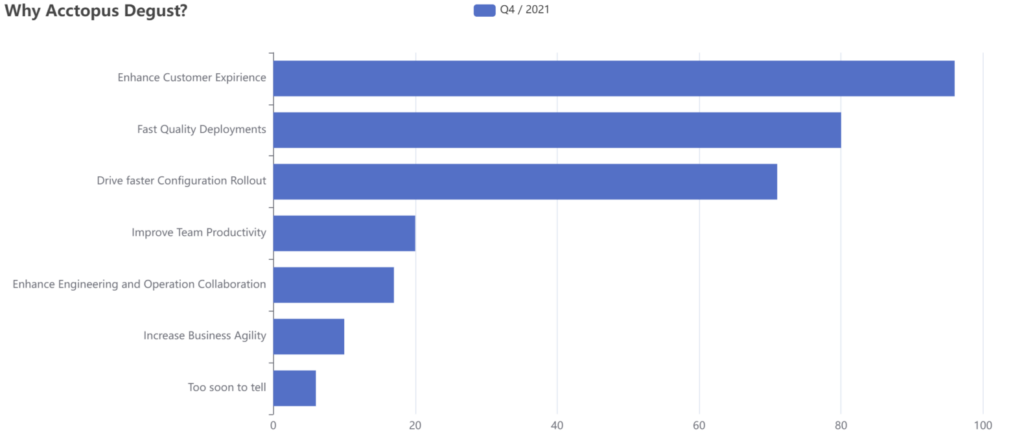
What you get: Best customer experience for products you provide to your customers Risk-free deployments on any configuration or new functionality Thousands of regular regression tests in your live network We did our yearly online survey in December 2021. Again, our customers are looking to provide their users and customers with a best-in-class network experience. They value our approach to provide fast quality deployments and updates of their core and edge systems. This is achieved by constantly monitoring and testing thousands of KPIs. As soon quality is below the threshold set by the operations teams, Degust will raise an alert into customers’ management systems.

Why Customers use our Quality Automation Service Read More »

Web Automation 5.0

Bring the quality of your web projects to the next level. You are constantly testing your web projects using tools like Ranorex Studio, Katalon or basic Selenium? Combine your knowledge and existing tools with complete End-2-End testing and monitoring of the involved backend systems.  If you use tools like standard web driver automation, you will always compare expectations with the real world. But you can only see the results from the front-end view. In all cases, where the problem is within the backend, your test throws an error or will at least ask you for manual evaluation. Using Degust you can automate even these steps. Degust will be integrated with your frontend tests by getting raw information from your backend systems, like databases, authentication systems, and 3rd party apps. This may turn your result and limit the effort to troubleshoot the real source of your problems.  Additionally, Degust will run your tests on thousands of systems in parallel, if required from different countries or continents. How to use… Degust is designed to issue tests against all kinds of systems. As part of these tests, the user can configure complete web browser sessions to check the state of the development in an agile scenario. Degust is also scaled to run these tests in thousands of different situations from certain sources controlled or in parallel. Currently, our customers are issuing 4 MM such tests per day. This turns ‘Testing’ into ‘Monitoring’ and is the final bit, no other solution is designed for in the first place.

Web Automation 5.0 Read More »

Run your IoT on Degust

You are starting a new project and need to run your new software in different locations or even in certain countries. Some customers have great developing resources, but they don’t want to invest or simply don’t have the time to develop the potentially global networking, monitoring, and security infrastructure underknees. This will always lead to challenges when it comes to updating their software or monitoring the systems or if they want to scale above some hundreds of systems. Using Degust, customers will install a downloadable image onto their systems and backpack it with their own programs and scripts. They are still in 100% control over their systems, but Degust takes care of monitoring, benchmarking, and software release management. Instead of starting with months of planning and evaluating, you can start in hours at a small monthly fee per device.

Run your IoT on Degust Read More »

Acctopus develops first 5G AUSF

The Authentication Server Function (AUSF) is used in 5G networks to authenticate users or systems to the 5G network. The AUSF is part of the Acctopus NetMaut Policy Platform for mobile operators and thus is seamlessly being used together with services in the 2G-4G area. It provides authentication services and other security-related services to the 5G Core network through the Nausf Service-Based Interface. The AUSF authenticates the user equipment using information queries from the Nudm_UEAuthentication Service and uses the method specified and required by the service consumer. Where required, it calculates the keys necessary to protect a list or steering information. Allow 5G tests and monitoring using Acctopus Degust As Acctopus NetMaut and Degust are sharing code bases and functionality, the 5G Authentication Server Function became part of Degust Quality Automation Service. Degust subscribers have now access to the AUSF and will integrate the functionality into their tests and monitoring to speed up acceptance procedures and go-live project plans.

Acctopus develops first 5G AUSF Read More »

NetMaut exceeded 30 MM Subscribers

Our Authentication, Policy, and Charging platform Acctopus NetMaut exceeded 30 MM subscribers in RADIUS Authentication, 3GPP Gx PCRF policy, and 3GPP Gy OCS charging in a single customer’s installation. Thanks to our team, the service could run flawlessly while scaling out over the past months. We all love numbers: 20 MM mobile sessions / day240 MM RADIUS messages / day420 MM Diameter Gx policy messages / day600 MM Diameter Gy charging messages / day All tested and monitored using Acctopus Degust The quality is kept at its maximum by constantly testing all possible situations 24/7 Raw signaling RADIUS, Diameter, LDAP  E2E testing mobile sessions Global testing using SIM distribution agile testing during integration and configuration …  

NetMaut exceeded 30 MM Subscribers Read More »